
Reading to Live
On the Miracle of the Imagination

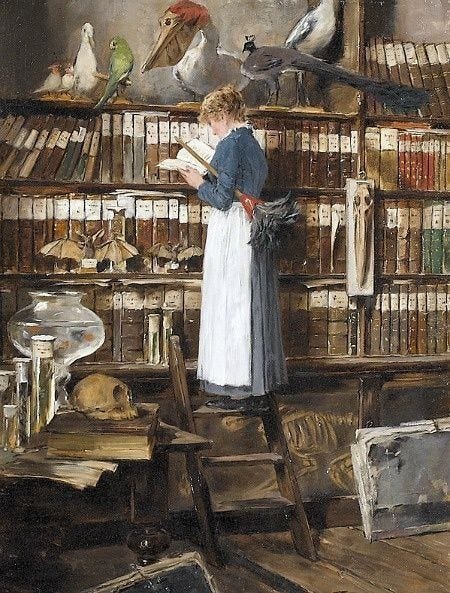
The benefits of reading are beyond listing—among them the expansion of the imagination, cultivation of our capacity for empathy, the furthering of knowledge—and every one of them has had more impact on the way I live than I am aware of. But there is none I am more grateful for than the rediscovery of the world.
The adage which holds so true, that “Fact is stranger than fiction,” could be taken a bit further: Fact, or Reality or Life, is also more beautiful, terrible, wondrous, heartbreaking, surprising, and disastrous than the most evocative fiction. People in my life have been surprised when I have expressed this feeling, apparently defying some expectation they held about me as an avid reader. I am one who keeps to my books, and so I’ve been asked more than once (earnestly, not maliciously) if the company of the bizarre characters of Dostoevsky or Twain are so much more interesting than those I find in real life.
Nothing could be further from reality, I tell my questioner, really nothing! Why, real people are not only immeasurably more interesting than those in my books, but also much more preferable company (my favorite characters aren’t people I’d really care to meet, and I’m honestly not sure if I’d like them if I did). To my shock, others are always shocked when I say this.
It is a simple concept which I can understand can be misunderstood from the outside looking in, but I think most readers will understand what I am saying:
I don’t keep so much to my books because I don’t like people or real life. Reading’s “escapism,” as Tolkien noted, is not the “flight of the deserter” seeking to ignore the fact of life,1 but is rather the search for an ever-greater depth of this curious reality.
One of the greatest delights is to sit outside in the shade of a tree amidst the birdsong with a novel or some poetry—but I am not, as it could be assumed, opening my book out of scorn for the beauty around me. Just the opposite! My novel lets me—by some miraculous blending of the spirit, mind, and body—attend better to my reality. Rather than drawing me out, it draws me only ever deeper in. Lewis made the point in encouraging children to read fairytales:
“[A child] does not despise real woods because he has read of enchanted wood: the reading makes all real woods a little enchanted.”2
What occurs is a fundamental shaping of the eye—not to see things which are not there, but to be attuned to all the colors of a world lying beyond the deadened rationalization we have blanketed over its intrinsic myths.3
“Fortis imaginatio generat casum” (Montaigne, “On the Power of Imagination”).
“A strong imagination creates reality.”
The imagination is the great thing at work here, which Lewis elsewhere calls the “organ of meaning.” Having first lived and experienced reality tangibly (an essential first step), I can discover it anew—really fundamentally anew—as a result of having read it. A setting sun is all the more spectacular for having read it described as shipwrecked.4 Trees take on greater reality for being Ents. Rivers sparkle more brightly when filled with nymphs, and even people appear more real when I wonder what possible secret lives they might be living. In reading, the “film of familiarity”5 which inattentive living drapes over the splendor of the ordinary world can be lifted.
Though a bit overly Romantic for my taste, Percy Shelley emphasizes the significance of poetry’s relationship with reality in the context of Rome:
“The imagination, beholding the beauty of this order, created [poetry] out of itself according to its own idea; the consequence was empire, and the reward ever-living fame. These things … are episodes of that cyclic poem written by Time upon the memories of men. The Past, like an inspired rhapsodist, fills the theatre of everlasting generations with their harmony.”6
For Shelley (and most of the Romantics), literature—poetry in particular—occupied a position of such creative significance that the world itself existed in a type of mystical relationship with it. In other words, the real world and the imagined scape of the artist and poet bleed into one another, inseparable, one cohesive apprehension of reality in which art and literature plays a necessary role. There is a union between poetry and life.7 Without reading, then, we lose some of that reality. William Blake aptly equated imagination with “the Divine Vision” as the “one Power [which] alone makes a poet.”
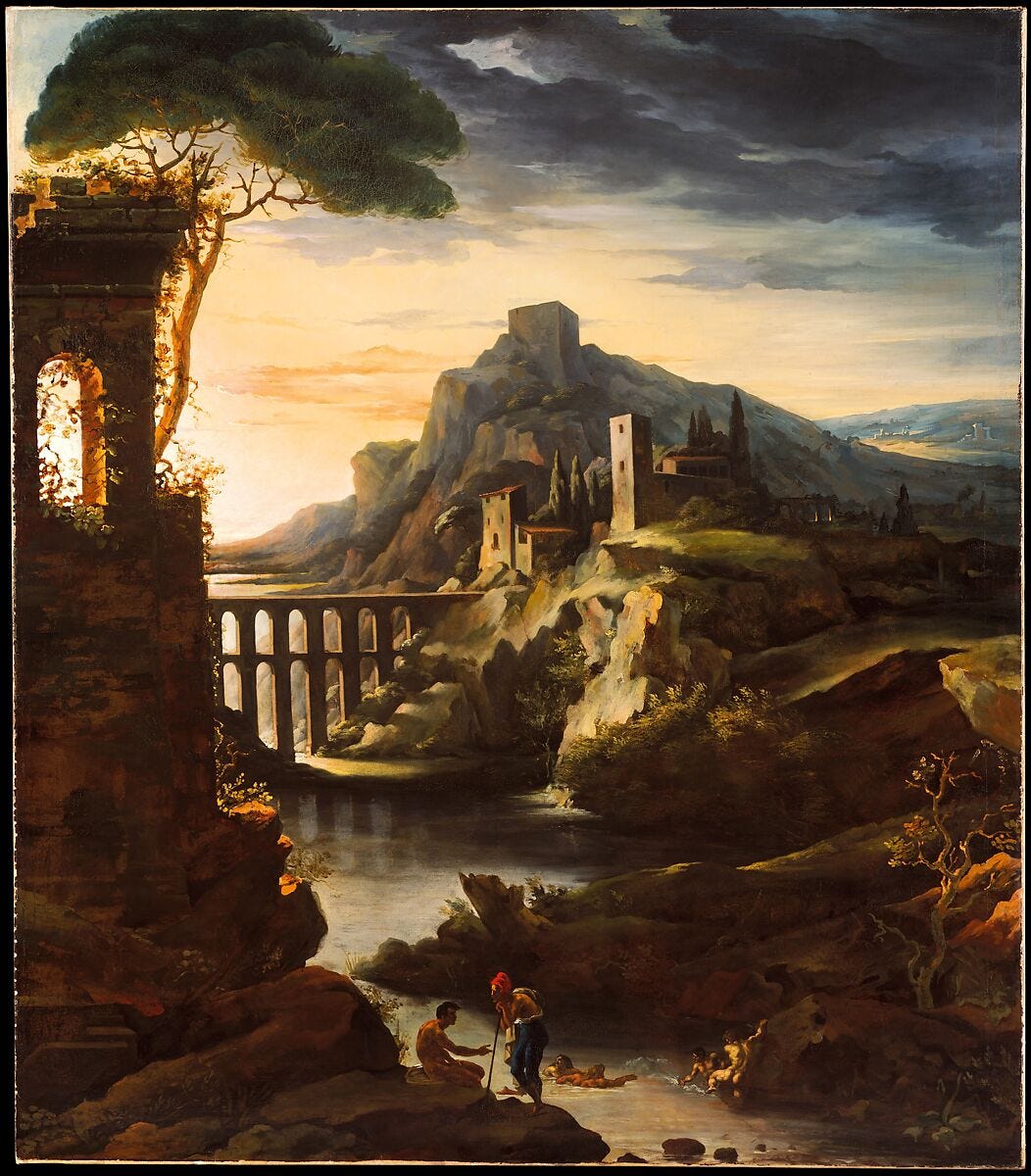
I don’t like the image of the world as a “blank canvas,” suggesting that all meaning must be ascribed onto it from an external source, that all meaning is subjective to the experience of the beholder, but there is something to the idea of phenomenology, that the attention I bring to things changes their nature on account of my interaction with them. The world and its wonders contain meaning intrinsically, God-breathed, and life is in part the work of ascertaining that meaning—and that meaning is a well forever yielding drink. Writers, poets, artists have found some of it and packaged it up to open my eyes a little wider, draw me in a little closer, so that I may walk through the same world again and again and every time find it new—not merely “novel” or unfamiliar, but really new, imbued with the fresh glow of previously unseen meaning. This is in part what is meant by enchantment.
The role of art is exactly this pointing beyond itself; art (or, anyway, good art) must out of necessity be externally referential—it cannot stop at itself, but must draw the beholder’s attention back out beyond its plain and to the world. Lewis said it best in “The Weight of Glory”:
“The books or the music in which we thought the beauty was located will betray us if we trust to them; it was not in them, it only came through them, and what came through them was longing.”
This is what I mean when I say that Life surpasses Fiction in every sense, and that the people of Life are far greater than those of Fiction. The best fiction is that which turns my attention back out.
And what a miracle this is—that by retreating for a short while into the imagination I can return to a world which is increasingly magnificent, full of the splendor of the ordinary, and that in reading my senses can by some extraordinary cause become more refined to identifying that splendor! We might say that artists—writers—teach us how to live in the world.
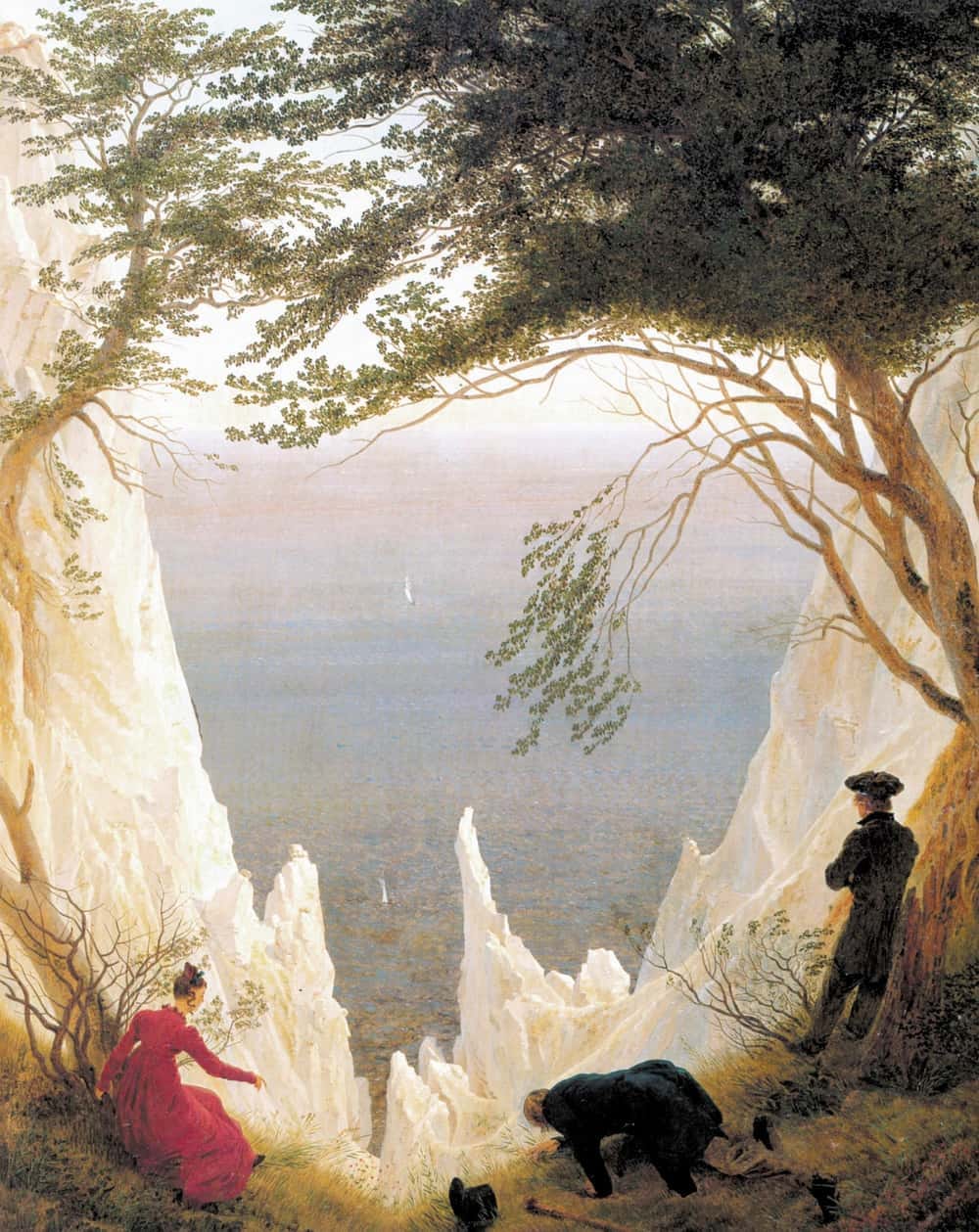
It is a rediscovery of people, too, the earth’s greatest wonder. The most eccentric of characters come up in real life with ten times the intrigue, and indeed Dostoevsky and Twain and Austen and Doyle and Dickens and Shakespeare have trained my eye to notice and be fascinated by them.
Reading for the development of empathy is regularly talked about (Percy Shelley goes so far as to define the imagination as the “organ of the moral nature of man” whose circumference is enlarged by poetry8), and it is worthwhile to note that reading instills the habit of investing in others’ perspectives. For Iris Murdoch, the novel at its core is “par excellence the form of art most concerned with the existence of other persons,”9 and the novelist is responsible for attuning the attention to the very reality of persons outside of the self.
Thus, beyond Shelley’s theory that literature, specifically poetry, serves the principal purpose of instilling empathy and making us “good,” I think the effect of reading as regards human relationship is much more basic: Just as reading taught me to see the world new (and really imbues the world with newness), it evinced beyond anything that people are inherently interesting, that they carry in themselves whole worlds independent of mine, that they could be anyone and that there is no person on earth about whom great literature could not be written. There are indeed Gatsbys, Oliver Twists, Huckleberry Finns, Odysseuses, Atticus Finches, Jo Marches, Scrooges, and Bilbo Bagginses out at every turn. Reading grants me knowledge of an “other” and, through empathy, lets me be attentive to the “other” as independent of me for their own sake. It is only from this attention that empathy and love can emerge.
In his (exceptional) novel The Name of the Rose, Umberto Eco says that “‘We live for books…in this world dominated by disorder and decay,’” and, for all his brilliance, I could not think him (or his characters) more wrong.
Disorder and decay live in the world, but the world is certainly not dominated by them, else we fall into an uncomely nihilism. To live for books is to treat reading as an end in itself, to stop at the self and whatever pleasure we might gain from literature and the imagination—and in a nihilistic world, this is understandably a preferable end. But the real value of reading in our non-nihilistic world, where beauty and goodness and purpose thrive, is just the opposite: Life is the ultimate toward which reading reaches; life is not in service to the books, but the books to a life of value striving toward Heaven.
Life has always been stranger and more wondrous than the best of fiction; this is not a devaluing of fiction so much as a testament to the affective power of real life.
In reading, the world every day is new, peopled with more wonders (and terrors) than we could ask for. It might be a bit like rebirth, that with every piece of writing or art the world is born again so we are both of us (myself and the world) new encountering one another, and in so doing I glimpse more of the face of God whose eternity is inexhaustibly extraordinary. In the end, by living and reading and living again, I ultimately rediscover my God.
What sorts of impact has reading made on your life and the way you live in the world? Do you agree that reading exists in service to life, that it cannot be an end of its own? I’d love to know your thoughts.
“Why should a man be scorned if, finding himself in prison, he tries to get out and go home? Or if, when he cannot do so, he thinks and talks about other topics than jailors and prison-walls? The world outside has not become less real because the prisoner cannot see it. In using Escape in this way, the critics have used the wrong word, and, what is more, they are confusing, not always by sincere error, the Escape of the Prisoner with the Flight of the Deserter” (Tolkien, “On Fairy-Stories”).
Lewis, C.S. “On Three Ways of Writing for Children,” Of Other Worlds.
“Myths” not in the sense of “falsehoods,” but rather a type of experience with the world which rises above rationalistic terms. In the forward to Rolland Hein’s Christian Mythmakers, Clyde S. Kilby writes, “A blade of grass really seen, anything really seen, suggests the transcendental nature of myth. Myth is the name of a way of seeing, a way of knowing in depth, a way of experiencing…. Myth is vision…. [Man] is fundamentally mythic.”
“The sun shipwrecked west on a pearl / and the moon swam out of its hull” (Dylan Thomas, “Ballad of the Long-Legged Bait”).
Coleridge, Samuel Taylor. “Chapter XIV,” Biographia Literaria.
Shelley, Percy. “A Defense of Poetry.”
I am using “poetry” here to loosely include literature and the act of reading as a whole, though I do believe there is a distinction between the unique power of poetry and other forms of literature. That is too much to include in this article, however, and once I have it a bit more sorted out I might write specifically on that distinction. For now, I will treat “poetry/literature” the way I am treating “artist/writer.” For my pedantic readers, rest assured that you are right.
Shelley, Percy. “A Defense of Poetry.”
Murdoch, Iris. “The Sublime and the Beautiful Revisited.”
Emilia, your writing is beautiful as always. The whole time I was reading it, I was thinking of a quote by Flannery O'Connor: "I'm always irritated by people who imply that writing fiction is an escape from reality. It is a plunge into reality and it's very shocking to the system." I feel it's a wonderful shock to the system, and by being electrified, the colors of reality grow more vibrant.
I especially loved your point about treating reading as a retreat and an end in itself, and how it inevitably leads to nihilism. That was certainly my experience years ago, and since climbing out of that, I'm much more on your side; attuned to the rebirth and newness reading gifts us. Thank you for such a wonderful read!
Emilia, I am so happy to have found your Substack. You beautifully articulate things that are very important to me but that I have never puzzled out in words. Yes, reading enhances life. Because I read I live more fully. I’m always a little regretful when people who are dear to me don’t share in this beautiful multiplier. I would love to share my own substack, on Christian film, with you. https://davidtheis385723.substack.com/p/thank-god-im-an-atheist?r=18lea&utm_medium=ios