
On the Epiphany
A Meditation on Childlikeness, the Christ-child, and "La Befana"

The twelfth day of Christmas, January 6th, the Epiphany, has been held throughout Christian history as a day of festivity comparable even to Christmas itself. The Epiphany, though supremely worthy of our meditation, has in modern times—and especially for American Protestantism—lost some of its effect. This is a pity, for the Epiphany denotes the day that God Incarnate was made known to the world at large and holds in itself the summation of the Christmas sentiment we would do well to hold in our hearts all year.
La Befana: An Italian Legend
Growing up in an Italian home, for my brother and I January 6th was as exciting as Christmas morning: as kids we woke to a small gift—some chocolate, an article of clothing, even a book—not from Santa Claus, but from La Befana.
According to Italian legend, La Befana was an old woman living in Italy at the time of Jesus’ birth. There are different variations of the legend, but the most common say she was one night visited by the Magi on their way to find the Christ-child, who asked if she knew anything about the event. She knew nothing and sent the Magi on their way, but, herself a childless widow, she was moved by the men’s description of a poor child born somewhere this night who would be King—was so moved in fact that she decided to head out herself to find the baby and bring Him a gift.
Per tradition, she traveled all throughout the Italian peninsula and, not knowing which child was the one the Magi sought, delivered a small gift to (and, amusingly, cleaned the home of) every Italian child she found—as she continues to do every January 6th, in Santa-fashion, to ensure that every child has some toy or candy to bring them joy.
I remember one year when my family were visiting my grandmother living in Italy, my brother and I, along with all the neighborhood children, ran out to the balconies at midnight on January 5th to see if we could catch sight of La Befana on her voyage, who is said to traverse Italy airborne on the broomstick with which she sweeps the children’s homes.
The story of La Befana always made me a little bit sad: This kind old woman has been searching for the Christ-child for 2,000 years, delivering gifts to every child except Him, relentlessly determined to bring Him a gift. As a child, I wondered when she would ever stop, conflicted between the idea that she knows that she will never find the Christ-child but enjoys giving gifts to Italian children, or that she is yet unaware of the time that has passed and still hopes only to happen upon the Babe in Mary’s arms.
A Child
This Christmas I was considering the fact that God was not given to us crucified, was not presented to us as hero or lord upon the clouds, but in fact presented as a baby. We are commanded to be like little children; Christmas is the hope of the Christ-child. The secularists are right: Childlikeness is the season’s heart and spirit.
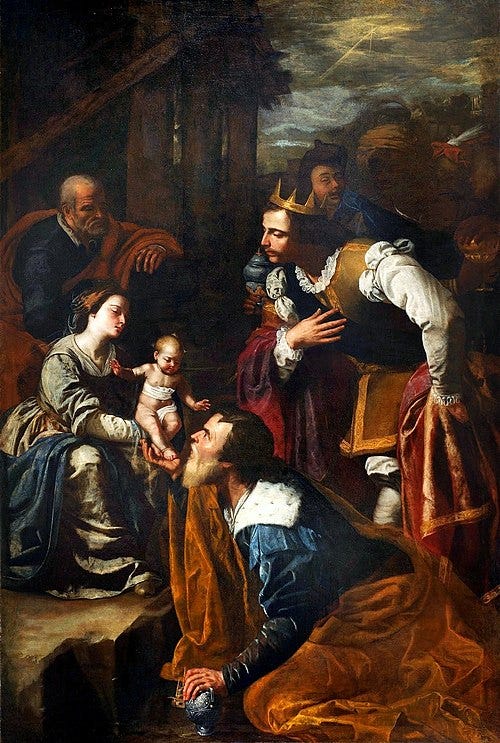
The Epiphany, when the Three Kings come to the manger, is the day that the world torn from God by sin is first admitted to behold the promise of their salvation: a Child. It is the day the world of which we are a part can finally glimpse the face of God, humbled as He is not merely into flesh or poverty but a baby born of a woman.
And La Befana? A woman of legend, herself mournfully childless, who catches wind of some babe born this night to be King of all, to whom even kings bring their gifts—she who hears of this is moved at once, determined to find Him and bring Him something befitting a child, sets out in search of Him, leaving a treat (and clean home) with any child she finds on the way so as to ensure both that she does not miss Him and that the world’s children may be loved.
Legend as it may be, is this not the spirit of Christmas—the determined search for the Christ-child, the consequential love for all His children in which we glimpse Himself? Year after year, 2,000 years, still La Befana seeks the King held in His Mother’s arms, laid to rest in a manger, and means to show Him love by showing love to the rest of the world.
Christians can be quick to look past Christmas to the Cross, to see the Passion and Resurrection here in the quiet communion of a Holy Family, and I understand the temptation, am guilty of it myself. Easter, after all, is the reason Christmas has significance.
But Christmas came to us at the Epiphany, and on that day all that the Earth knew of her Savior was a Child in a woman’s arms. The Wise Men, wise indeed, saw the King of eternity in the Baby’s face. This was how the God of all appeared to us sinners.
Christ-crucified is our salvation. Christ the divine gift of Heaven, perfect innocence, a Child, is our joy and the changing of our hearts. He is—or ought to be—our passionate search, His spirit in us leading our devotion to serve His people in turn. Let us come to the foot of the Cross every day of our lives; today on this Epiphany, let us come with three kings and an adoring old woman and the whole waking world to kneel at the Manger in which lies a Child.
How do you celebrate the Epiphany? What do you think about our call to childlikeness and how Jesus embodies that call? How does Christmas challenge us to fulfill it? I would love to hear your thoughts.
Thank you for sharing this! I have never heard the legend of La Befana. I love learning the ways different cultures engage the Christmas story. I’m really enjoying reflecting on Epiphany with others here.
That was a lovely story of La Befana, it was the first time i learned of it. The child-like wonder of Christianity, and that the Christian must be like little children, that is something that has been of much thought to me; it is one of the themes of the fiction manuscript i've been working on. For Christ, curiously, i realized i never wondered of Him in relation childlike, as i thought of Him more as the Shepherd that will take care of us sheep and give the children blessing and rest; as the Child, yes, when He was a Child, also there is that He is the Son of God, and so when reading your question about how Jesus embodied the call to childlikeness, the first thought that came to mind was how He obeyed and trusted the Father, and the prayer in the garden of Gethsemane.